Quality & materials
What goes into our products
Good products come down to the material, the finish, and the hardware. This page covers every material we build in, the sheet steel and tube behind the storage and the frames, the board and surfaces on the desks and cabinets, and the plastic and wood in the seating. Each section says what is standard, what can change for your project, and which ranges it governs.
Where we go further
Thickness with nothing hidden
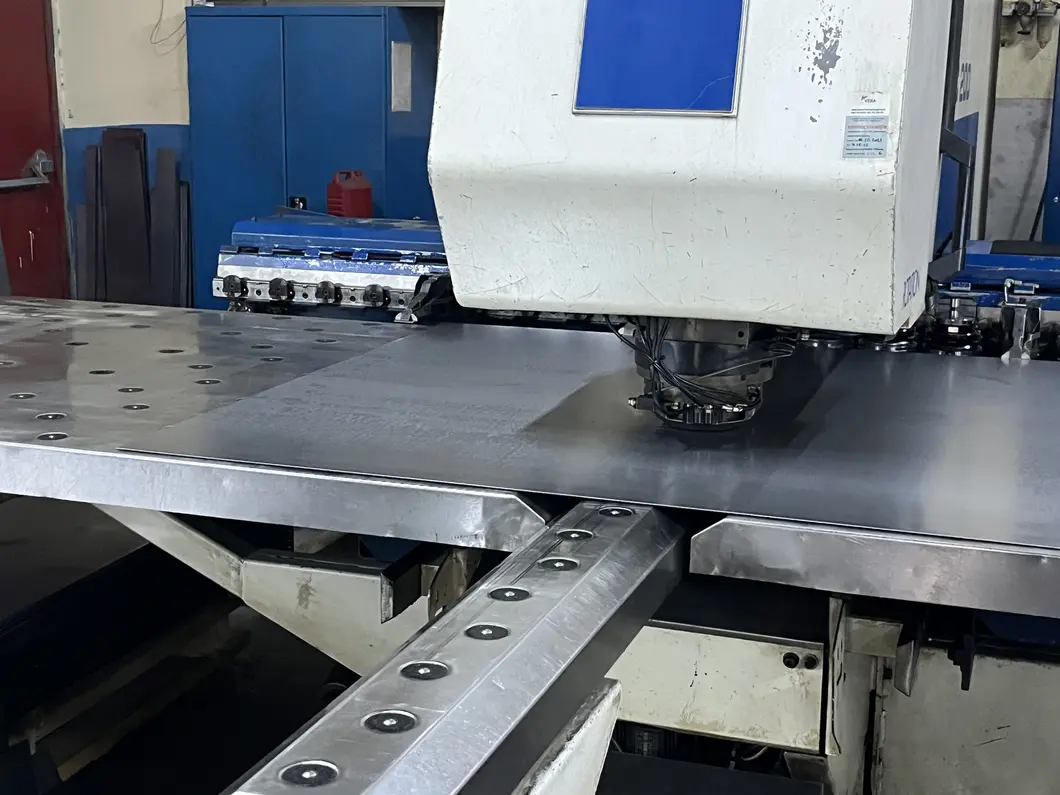
The thickness we quote is the bare steel before paint, not a figure inflated by the coating, and it runs through every part of the unit, not only the front.
Glides that protect floors
Legless cabinets sit on smooth glide feet, so they can be slid into position without scratching the floor or the cabinet base.
Honest advice on what's possible
We're straight about thickness and capacity. Where a requested thickness is not suitable for the construction, we will say so, and where a storage need is better served by the medium duty shelving we supply, we will point you there instead.
Sheet steel
The bodies of our steel lockers and archive cabinets are cold-rolled DC01 steel to EN 10130, Turkish in origin. Standard thickness is 0.70 mm, with 0.50, 0.60, or 0.90 mm available where the size and capacity of a model allow it. Compact mobile archive bodies run heavier, 0.80 mm as standard with 1.0 or 1.2 mm on request, and nothing thinner than 0.80 mm on those systems. The figure we quote is the bare steel, measured before paint.
| Steel | Cold-rolled DC01 (EN 10130) |
|---|---|
| Origin | Made in Turkey |
| Standard thickness | 0.70 mm (measured excluding paint) |
| Optional thickness | 0.50, 0.60, or 0.90 mm, where size and capacity allow |
| Compact mobile archive | 0.80 mm standard, 1.0 or 1.2 mm on request, nothing thinner than 0.80 mm |
| Typical yield strength | ~261 N/mm² |
| Typical tensile strength | ~360 N/mm² |
| Typical elongation (A80) | ~31% |
| Mill certificates | EN 10204, on request |
The thickness we quote is used on every part, not only the door. We don't thin the back or shelves to cut cost.
Tube and profile
Where a product is a frame rather than a body, it is built from steel tube and channel instead of sheet. That covers metal bunk beds, the chairs, desks, and tables in our school furniture range, and the frames under our office furniture.
| Uprights and side rails | EN 10219 grade S235JRH, on the bunk beds |
|---|---|
| Slat, rail, and ladder infill | EN 10305-3 grade E190, on the bunk beds |
| Mill certificates | EN 10204, per batch on request |
| Wall thickness | 0.8 to 1.5 mm across the range |
| Sections | Square and rectangular box, C-channel, and elliptical tube |
| Finish | Powder coated, covered under Finish and color below |
| Origin | Made in Turkey |
Box section carries the load on almost everything. C-channel appears only on the bunk side rails, at 120 × 40 mm, where a channel takes the bed base better than a closed tube would. Elliptical tube is used on the school desks and sets, at 25 × 50 mm, because an ellipse gives a student a flatter face to sit against than a square edge does.
The two grades above are the ones we publish, and they are published on the bunk beds. On the chairs, desks, and tables we state the section and the wall thickness on each product page rather than a grade. If your specification needs a grade named on those, ask and we confirm it for your order.
The shelving and racking we supply is specified differently again, because the steel is chosen against the load rather than against a body size. It comes in S235 and S355 grades to suit the configuration, with uprights at 30 × 70 mm as standard and 30 × 90 mm on the taller gondolas and heavier loads. Powder coating runs around 70 micron using a Qualicoat approved coating, and uprights and steel shelf panels can be supplied on a hot dip galvanized substrate, DX51D+Z with a Z100 coating, instead. Material and coating documentation is available on request.
Board and surfaces
Alongside steel, we build wooden lockers and cabinets, mostly office and staff file cabinets and teachers' wardrobes. These are made to order, so the internal layout is set to the job rather than to a fixed model. The same board runs through our office furniture and the tables and desks in our school furniture range.
Not every top is melamine-faced board. Werzalit is a compressed board with a decorative surface, used on the canteen table set and as one top choice on the school desks, maple as standard with other colors on request. Plywood is one of the desktop options on the school desk and chair sets, and laminate decors run on the classroom tables, the teacher desk, and the office range. Bunk beds use board differently again, an 18 mm melamine-faced chipboard headboard panel, and an MDF bed base panel where a buyer does not want wire mesh.
| Board | Melamine-faced chipboard or melamine-faced MDF |
|---|---|
| Body, shelves, doors | 18 mm |
| Back panel | 8 mm |
| Edge banding | 0.80 mm standard, with 0.40, 1, or 2 mm on request |
| Finish | Melamine, lacquer, or paint |
| Standard decors | Maple, white, oak, walnut, with the closest available match for other colors |
| Werzalit | Compressed board with a decorative surface, maple as standard, on canteen and school tops |
| Other tops | Plywood and laminate decors, by model |
| Board on bunk beds | 18 mm melamine-faced chipboard headboards, optional MDF bed base panels |
| Hinges | Standard, anti-pinch, or piano, for child safety |
| Feet | 5 cm adjustable feet as standard, with longer feet, a legless base, or wooden feet on request |
| Origin | Made in Turkey |
Common builds include a full-height cabinet with shelves behind a door, a lower lockable section under open shelving, glass or plexiglass door panels, and a hanging-rail wardrobe for staff. The shelf count is set to the job and is not capped, so if you need seven or eight shelves we build seven or eight. A tall cabinet at only 36 cm deep can tip, so anti-tip hardware is standard on the 185 cm height. A wall bracket that holds the unit to the wall is available on request. So are rounded corners and plywood. Wood units carry the same 2-year warranty as our steel range.
Plastic and seating
Seating is the one range where the material a buyer sits on is not steel or board. Our school chairs come with a plastic shell or a wooden seat, on the steel frames covered under Tube and profile above.
| Shell | One piece HDPE, 420 × 420 mm seat, backrest height 370 mm |
|---|---|
| Shell colors | 12 standard, others reviewed by project |
| Classic chair seat | Wooden standard, PP on request |
| Adjustable desk seat | Beech |
| Origin | Made in Turkey |
The HDPE shell is one piece, so the seat and the backrest are the same molding rather than two parts fixed together. The same shell runs across the plastic, stackable, and Z-frame chairs, and only the frame under it changes. On the classic chair the seat and backrest are wooden as standard, with a PP seat and backrest on request. The height adjustable and single student desks take a beech seat.
Finish and color
On steel lockers, archive cabinets, and steel furniture, after the surface is cleaned and any weld marks are smoothed, parts get a powder coat at a standard film thickness of 60 to 80 microns. We use a powder coating that holds Qualicoat and GSB approvals, is UV-resistant, and non-yellowing, and you can choose a gloss or matte finish. Wooden lockers and cabinets are finished in melamine, lacquer, or paint, covered under Board and surfaces above.
Metal bunk beds are the exception. They carry a heavier electrostatic coat at 80 to 120 microns, because a bed frame is handled, stacked, and moved far more than a locker is. That coat is tested to ISO 2409 for adhesion, ISO 22479 for corrosion resistance, and ISO 16474-2 for weathering.
The antibacterial powder coat is tested to JIS Z 2801, the international test for antibacterial surfaces, with a measured activity value above 2.0. It is available on request, on steel lockers, and is not the standard coating. It suits changing rooms, gyms, clinics, and other high-contact settings.
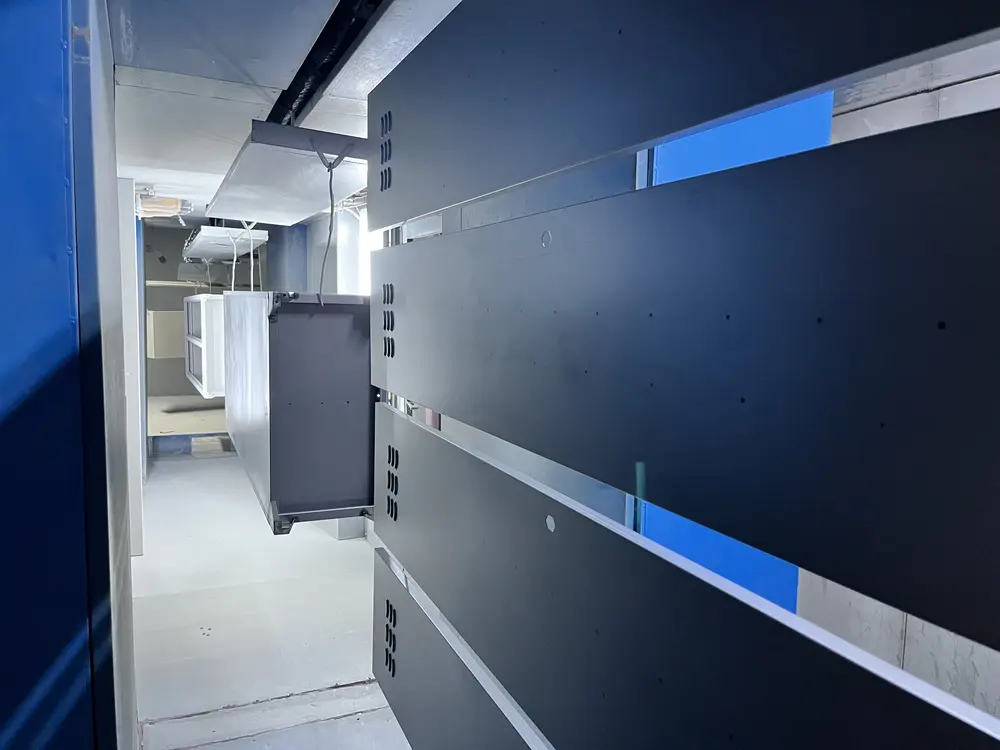
On steel, twelve standard RAL colors are kept ready, and any other RAL is available on request as part of our custom and OEM work.
On-screen colors are approximate. Ask for a sample to confirm a shade before you order.
Locks and hardware
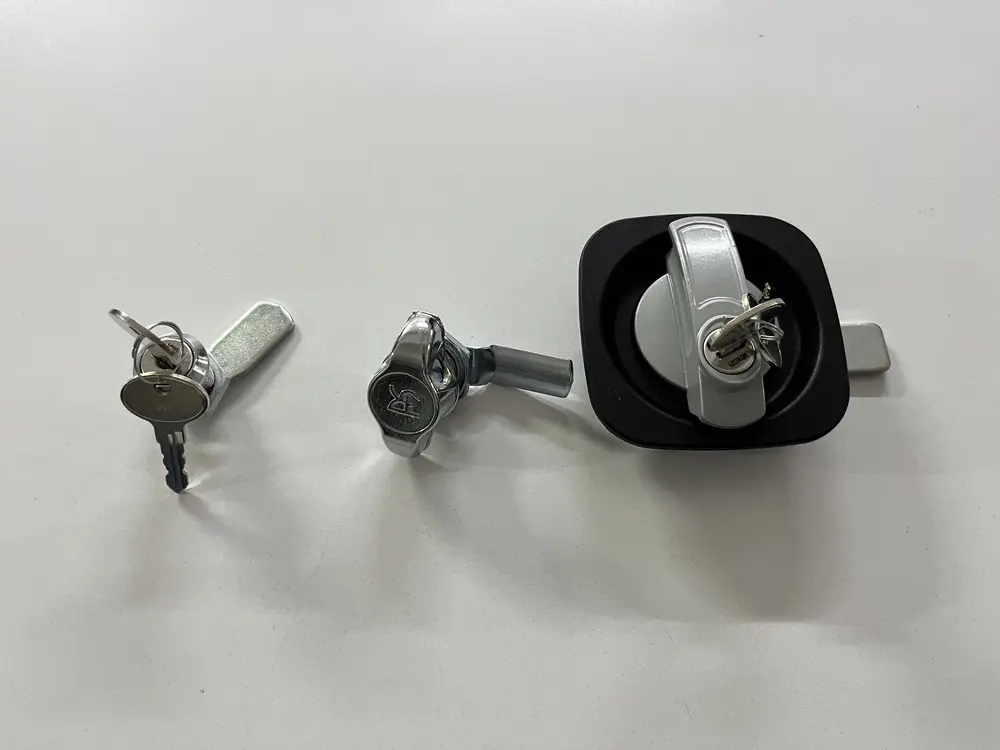
Every locker comes with a padlock hasp as standard, so you can fit your own padlock. We also offer key (cam) locks and electronic locking with a PIN, RFID card, or fingerprint. Locking can be single-point or three-point, and if you'd rather use your own lock we'll cut the opening to match it. On our archive cabinets the standard is a key lock that secures the door at three points, top, bottom, and side, with a padlock hasp available on request.
Locks belong to the storage ranges. Seating, tables, and desks carry none, so nothing in this section applies to them.
Standard on most models
- Concealed hinges
- Ventilation slots
- Name-plate holder
- Smooth glide feet on legless cabinets
Options
- Hanging rail or coat hooks
- Reinforced shelves for heavier loads
- Bench, sloping top, or plinth
- Number or label plates
- Private-label branding
Certifications and documentation
Our quality management is certified to ISO 9001:2015. For the applicable models we can provide product compliance documentation, along with steel mill certificates (EN 10204) and coating certificates, on request. The mill certificate covers the steel batch used on your order, so the material can be traced back to the mill. See Export & logistics for the full document set.
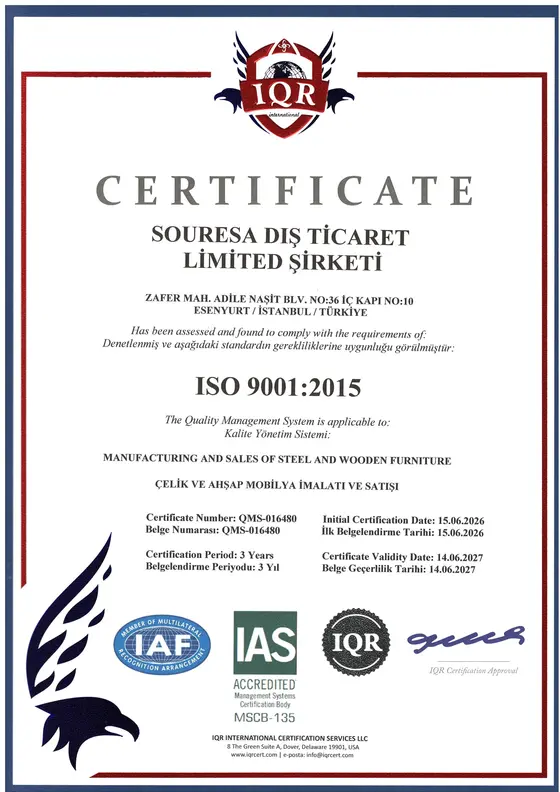
ISO 9001:2015 — Quality Management System
- Certificate no. QMS-016480
- Scope Manufacturing and sales of steel and wooden furniture
- Issued to SOURESA DIŞ TİCARET LİMİTED ŞİRKETİ
- Certification body IQR International Certification Services (IAS-accredited, MSCB-135)
- Valid until 14 June 2027
It is a management-system certificate, not a product approval.
Tell us your specification
Send your sizes, quantities, and specifications, and we'll advise on the best build and prepare a quote.
Get a quote